4 Educational Philosophies
These educational philosophical approaches are currently used in classrooms the world over. They are Perennialism, Essentialism, Progressivism, and Reconstructionism. These educational philosophies. Some people think that Behaviorism, Cognitivism, Humanism, and Constructivism are philosophies of education that focus on who to teach and how to teach. May 21, 2014 at 7:59 AM Post a Comment.
- Educational Philosophies In The Classroom
- Educational Philosophies Pdf
- 4 Major Educational Philosophies
- Educational Philosophies Quotes
- 4 Educational Philosophies
Section III - Philosophical Perspectives in Education Part 3. Educational Philosophies. Within the epistemological frame that focuses on the nature of knowledge and how we come to know, there are four major educational philosophies, each related to one or more of the general or world philosophies. Spread the love. Student-centered philosophies are another essential philosophy that educators should be aware of. By focusing on the needs of students, teachers are able to assist and teach students within the classroom ensuring a higher level of student success. In this article three types of student-centered philosophies will be discussed which are progressivism, social reconstructionism, and existentialism.
by Natasha Kenny and Carol Berenson
We often support instructors in creating teaching philosophy statements, and various resources exist to support their development (e.g. Chism, 1998; Kenny, Jeffs, and Berenson, 2015; Schonwetter et al., 2002). However, few resources are available to help faculty in preparing educational leadership philosophy statements.
We recently created a resource to help faculty preparing educational leadership philosophy statements as part of their nomination dossiers for institutional and national awards, such as the University of Calgary Teaching Award for Educational Leadership and the 3M National Teaching Fellowship.
Similar in format to a teaching philosophy statement, an educational leadership philosophy statement “clearly communicate[s] what our beliefs are about educational leadership, why we hold these beliefs and how we translate our beliefs into practice” (Berenson and Kenny, 2015). An example structure for an educational leadership philosophy statement and guiding questions to help those preparing a statement are presented in Table 1 below. While every statement will uniquely articulate the educational leadership beliefs and practices of each author, these questions provide a foundational guide for helping to support faculty in creating an educational leadership philosophy statement.
Dr. Ken MacMillan, 3M National Teaching Fellow, and the 2015 recipient of the UCalgary Award for Educational Leadership) has shared an example educational leadership philosophy statement here.
Table 1: Key components of a teaching philosophy statement with guiding questions for reflection.

Questions adapted from: Kearns, K.D. & Sullivan, C.S. (2011); Kenny, Jeffs & Berenson (2015); Stavros & Hinrichs (2011); Schonwetter et al. (2002); Seldin, P., Miller, J. E., & Seldin, C. A. (2010).
| Philosophy Statement Components | Guiding Questions |
| Beliefs about educational leadership | What are my beliefs about educational leadership in post-secondary education? Why do I hold these beliefs? Who or what has most informed my leadership approaches? How have my beliefs been influenced by my experiences postsecondary educator and/or scholarly literature related to leadership? What difference do I hope to make as a leader? What does it mean to be a good leader in a post-secondary context? |
| Educational leadership activities and initiatives | What educational leadership activities, practices and initiatives have I implemented? How do these align with my beliefs? When have I felt most engaged and affirmed as an educational leader? What are my key strengths and skills as a leader? What am I most proud of? What sets me apart? What are some of my accomplishments as a post-secondary leader? |
| Impact and Influence | What difference have I made, and how do I know? What has been the impact and influence of my educational leadership (on me, on students, on colleagues, on my department, on my faculty, on the institution and beyond)? What have others learned from my leadership approaches? |
| Future Aspirations | How will I continue to develop, grow, and improve as a leader? What interests me most about teaching and learning in post-secondary education? What changes do I most hope to see and inspire? What are my future goals and aspirations as a leader in post-secondary education? |
Developing an educational leadership philosophy statement provides an opportunity for individuals to reflect on their own leadership beliefs and activities. This process also makes visible the many ways in which leadership is formally and informally enacted by individuals on our campus.
Educational Philosophies In The Classroom
References:
Berenson, C. & Kenny, N.A. (2016). Preparing an Educational Leadership Philosophy Statement. Calgary, AB: Taylor Institute for Teaching and Learning.
Chism, Nancy. (1998). Developing a philosophy of teaching statement. Essays on Teaching Excellence: Toward the Best in the Academy, 9, 1-3. Retrieved from http://podnetwork.org/content/uploads/V9-N3-Chism.pdf

Kearns, K.D. and Sullivan, C.S. (2011). Resources and practices to help graduate students and postdoctoral fellows write statements of teaching philosophy. Advances in Physiology Education, 35, 136-145.
Kenny, N.A., Jeffs, C., & Berenson, C. (2015). Preparing a Teaching Philosophy Statement. Calgary, AB: Taylor Institute for Teaching and Learning.
Schonwetter, D.J., Sokal, L., Friesen, M., & Taylor, L.K. (2002). Teaching philosophies reconsidered: A conceptual model for the development and evaluation of teaching philosophy statements. International Journal for Academic Development, 7(1), 83-97
Seldin, P., Miller, J. E., & Seldin, C. A. (2010). The teaching portfolio: A practical guide to improved performance and promotion/tenure decisions. John Wiley & Sons.
Stavros, Jacqueline M, & Hinrichs, Gina. (2011). The Thin Book Of SOAR: Building Strengths-Based Strategy: Thin Book Publishing.
Section III - Philosophical Perspectives in EducationPart 3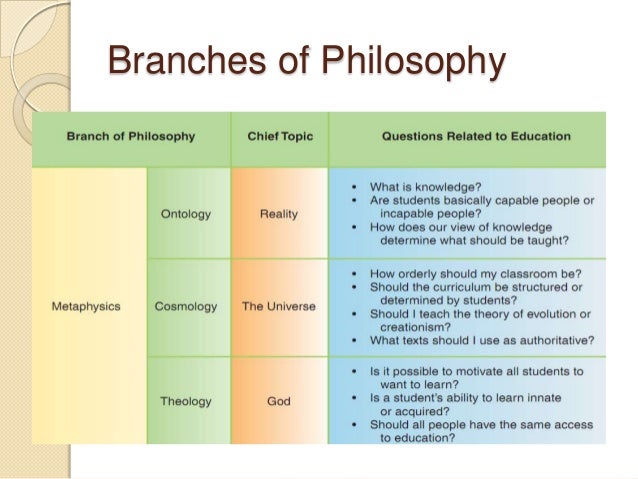
Educational Philosophies Pdf
Educational Philosophies
Within the epistemological frame that focuses on the nature of knowledge and how we come to know, there are four major educational philosophies, each related to one or more of the general or world philosophies just discussed. These educational philosophical approaches are currently used in classrooms the world over. They are Perennialism, Essentialism, Progressivism, and Reconstructionism. These educational philosophies focus heavily on WHAT we should teach, the curriculum aspect.
Perennialism
For Perennialists, the aim of education is to ensure that students acquire understandings about the great ideas of Western civilization. These ideas have the potential for solving problems in any era. The focus is to teach ideas that are everlasting, to seek enduring truths which are constant, not changing, as the natural and human worlds at their most essential level, do not change. Teaching these unchanging principles is critical. Humans are rational beings, and their minds need to be developed. Thus, cultivation of the intellect is the highest priority in a worthwhile education. The demanding curriculum focuses on attaining cultural literacy, stressing students' growth in enduring disciplines. The loftiest accomplishments of humankind are emphasized– the great works of literature and art, the laws or principles of science. Advocates of this educational philosophy are Robert Maynard Hutchins who developed a Great Books program in 1963 and Mortimer Adler, who further developed this curriculum based on 100 great books of western civilization.
Essentialism
Essentialists believe that there is a common core of knowledge that needs to be transmitted to students in a systematic, disciplined way. The emphasis in this conservative perspective is on intellectual and moral standards that schools should teach. The core of the curriculum is essential knowledge and skills and academic rigor. Although this educational philosophy is similar in some ways to Perennialism, Essentialists accept the idea that this core curriculum may change. Schooling should be practical, preparing students to become valuable members of society. It should focus on facts-the objective reality out there--and 'the basics,' training students to read, write, speak, and compute clearly and logically. Schools should not try to set or influence policies. Students should be taught hard work, respect for authority, and discipline. Teachers are to help students keep their non-productive instincts in check, such as aggression or mindlessness. This approach was in reaction to progressivist approaches prevalent in the 1920s and 30s. William Bagley, took progressivist approaches to task in the journal he formed in 1934. Other proponents of Essentialism are: James D. Koerner (1959), H. G. Rickover (1959), Paul Copperman (1978), and Theodore Sizer (1985).
4 Major Educational Philosophies
Progressivism
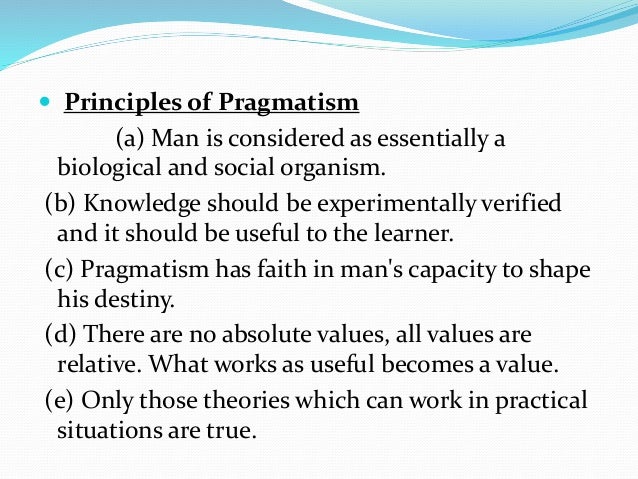
Progressivists believe that education should focus on the whole child, rather than on the content or the teacher. This educational philosophy stresses that students should test ideas by active experimentation. Learning is rooted in the questions of learners that arise through experiencing the world. It is active, not passive. The learner is a problem solver and thinker who makes meaning through his or her individual experience in the physical and cultural context. Effective teachers provide experiences so that students can learn by doing. Curriculum content is derived from student interests and questions. The scientific method is used by progressivist educators so that students can study matter and events systematically and first hand. The emphasis is on process-how one comes to know. The Progressive education philosophy was established in America from the mid 1920s through the mid 1950s. John Dewey was its foremost proponent. One of his tenets was that the school should improve the way of life of our citizens through experiencing freedom and democracy in schools. Shared decision making, planning of teachers with students, student-selected topics are all aspects. Books are tools, rather than authority.
Reconstructionism/Critical Theory
Social reconstructionism is a philosophy that emphasizes the addressing of social questions and a quest to create a better society and worldwide democracy. Reconstructionist educators focus on a curriculum that highlights social reform as the aim of education. Theodore Brameld (1904-1987) was the founder of social reconstructionism, in reaction against the realities of World War II. He recognized the potential for either human annihilation through technology and human cruelty or the capacity to create a beneficent society using technology and human compassion. George Counts (1889-1974) recognized that education was the means of preparing people for creating this new social order.
Educational Philosophies Quotes
Critical theorists, like social reconstructionists, believe that systems must be changed to overcome oppression and improve human conditions. Paulo Freire (1921-1997) was a Brazilian whose experiences living in poverty led him to champion education and literacy as the vehicle for social change. In his view, humans must learn to resist oppression and not become its victims, nor oppress others. To do so requires dialog and critical consciousness, the development of awareness to overcome domination and oppression. Rather than 'teaching as banking,' in which the educator deposits information into students' heads, Freire saw teaching and learning as a process of inquiry in which the child must invent and reinvent the world.
For social reconstructionists and critical theorists, curriculum focuses on student experience and taking social action on real problems, such as violence, hunger, international terrorism, inflation, and inequality. Strategies for dealing with controversial issues (particularly in social studies and literature), inquiry, dialogue, and multiple perspectives are the focus. Community-based learning and bringing the world into the classroom are also strategies.
Think about It:- Which of these educational philosophies would you describe as authoritarian? Which as non-authoritarian? Why?
- Each of the educational philosophies relates to one or more of the metaphysical world view philosophies. What connections do you see?
- Which educational philosophy is most compatible with your beliefs? Why?